Utility-Scale BESS OT Integration Architecture Review
$2,990.00
Is your BESS control and communications architecture ready for integration?
IACS Engineering provides an independent, vendor-agnostic engineering assessment of utility-scale Battery Energy Storage System (BESS) OT architecture.
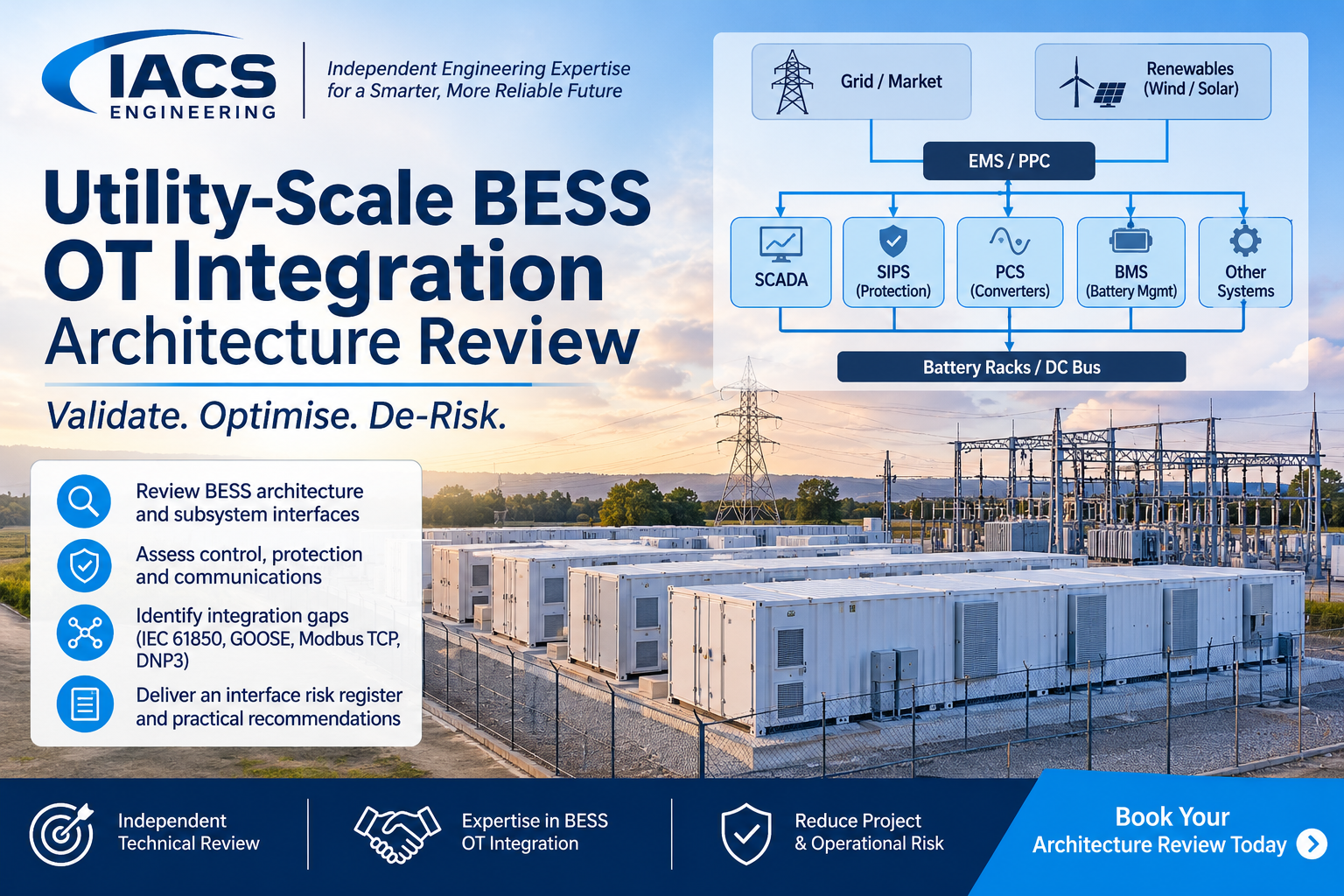
We review subsystem interfaces, control and protection arrangements, and industrial communication protocols across PPC, EMS, PCS, BMS and SCADA.
Deliverables:
- BESS OT architecture and interface review.
- Control, protection and communications gap assessment.
- IEC 61850, GOOSE, Modbus TCP and DNP3 review.
- Engineering Interface Risk Register.
- Technical findings and recommendations report.
Delivery: Within 2 weeks.
Suitable for BESS developers, EPC contractors, asset owners, OEMs and system integrators.
Description
Independent Engineering Assessment for Battery Energy Storage Projects
Utility-scale Battery Energy Storage Systems involve multiple interconnected control, protection, power conversion and supervisory systems.
Successful integration requires more than connecting individual equipment packages. The interfaces between the Power Plant Controller (PPC), Energy Management System (EMS), Power Conversion Systems (PCS), Battery Management Systems (BMS), SCADA and protection systems must be properly defined, coordinated and documented.
An incomplete or poorly defined OT architecture can introduce integration risks, communication failures, control conflicts, commissioning difficulties and operational limitations.
IACS Engineering provides an independent, vendor-agnostic BESS OT Integration Architecture Review to help identify these issues before they become costly project problems.
What We Review
1. BESS OT System Architecture
Review of the overall operational technology architecture, including:
- PPC and EMS architecture.
- PCS and inverter interfaces.
- BMS hierarchy and interfaces.
- SCADA and supervisory control architecture.
- Protection and interlocking interfaces.
- SIPS and other special protection interfaces, where applicable.
- Network segmentation and system connectivity.
2. Control and Functional Interfaces
Assessment of the functional relationships between BESS subsystems, including:
- Active and reactive power control interfaces.
- PPC-to-PCS setpoint and feedback exchange.
- EMS-to-PPC operational commands.
- BMS charge/discharge limits and permissives.
- PCS operating modes, status and fault indications.
- Start/stop sequences, interlocks and permissives.
- Emergency shutdown and trip interfaces.
- Control authority and command ownership.
3. Protection and Safety Interfaces
Review of the integration between control and protection systems, including:
- Protection relay interfaces.
- Trip and interlocking arrangements.
- Hardwired and network-based protection signals.
- GOOSE-based protection and status exchange, where applicable.
- Protection coordination interface requirements.
- Failure responses and communication-loss behaviour.
4. Industrial Communication Architecture
Review of communication interfaces and integration requirements, including:
- IEC 61850 MMS.
- IEC 61850 GOOSE.
- Modbus TCP.
- DNP3.
- OPC UA, where applicable.
- Ethernet network architecture.
- VLANs, network segmentation and traffic prioritisation.
- Communication redundancy and failure handling.
- Data mapping, signal ownership and interface responsibilities.
5. Integration Risk Assessment
Identification of potential engineering and integration gaps, including:
- Undefined subsystem interfaces.
- Missing or ambiguous control responsibilities.
- Inconsistent signal definitions.
- Missing permissives and interlocks.
- Communication and network design risks.
- Unclear failure and recovery behaviour.
- Potential commissioning and operational issues.
Engineering Deliverables
Following the review, IACS Engineering will provide:
- OT Architecture Review: Assessment of the submitted BESS architecture and subsystem interfaces.
- Interface Gap Assessment: Identification of missing, incomplete or ambiguous engineering interfaces.
- Interface Risk Register: Structured register documenting identified issues, potential consequences and recommended actions.
- Technical Recommendations: Practical recommendations to improve integration readiness, system coordination and engineering documentation.
- Engineering Findings Report: Consolidated findings and recommendations in a structured engineering report.
Who Should Use This Service?
This assessment is intended for:
- BESS developers and asset owners preparing new projects.
- EPC contractors developing BESS engineering packages.
- Electrical engineering consultancies reviewing system designs.
- BESS OEMs and system integrators coordinating multiple equipment vendors.
- Project teams preparing for detailed design, FAT, commissioning and integration.
Delivery Time
2 Weeks
The delivery period commences once the agreed scope is confirmed, the required project documentation is received and the initial project briefing is completed.
What We Need From You
To conduct a meaningful review, the customer should provide available project documentation, which may include:
- BESS Single Line Diagram (SLD).
- OT system architecture drawings.
- Control and functional architecture.
- Equipment and subsystem vendor information.
- Communication architecture and protocol specifications.
- Signal lists and interface schedules.
- Functional Design Specifications (FDS), if available.
- Protection and interlocking philosophy, where applicable.
The assessment will be based on the documentation supplied and the agreed review scope.
Why IACS Engineering?
IACS Engineering provides independent industrial automation, control systems and OT integration engineering expertise.
Our approach focuses on the engineering interfaces between systems, rather than simply reviewing individual equipment packages.
We help project stakeholders understand how their BESS subsystems communicate, coordinate, exchange control commands, respond to abnormal conditions and operate as an integrated system.
Independent Engineering. Practical Solutions.
Important Scope Clarification
This is an engineering architecture and interface review based on the agreed scope and documentation provided.
It does not automatically include detailed electrical design, grid-code compliance certification, protection coordination studies, cybersecurity penetration testing, OEM firmware validation, RTDS testing, FAT, SAT or commissioning.
Additional engineering activities can be quoted separately where required.
Ready to review your BESS OT integration architecture?
Engage IACS Engineering for an independent technical assessment.